Edge Metal, Coping & Gutters in Scranton, PA
The Roof Perimeter Is Where NEPA Winters Actually Do Their Damage
Ask us where a roof failure started on almost any older commercial building in the Scranton-Wilkes-Barre area, and the answer is more often the edge than the field of the roof. Coping, edge metal, and gutters take the worst of what a wet, heavy winter delivers here, and when those details fail, the water they were supposed to redirect goes somewhere else instead, usually into the wall assembly or the insulation right below the membrane termination.
Why the Edge Fails First Around Here
Snow drifts against parapets rather than melting evenly across a flat roof, which means the edge zone carries a heavier and longer-lasting load than the field of the roof for most of the winter. As that snow melts against a warmer section of roof and refreezes at the cold edge, it forms exactly the kind of ice dam that works its way under loose coping or behind edge metal that was not properly sealed and fastened in the first place.
Wind adds a second stress on top of that. Coping caps and edge metal on a large flat roof act like a sail in a strong gust, and any fastening that was installed to a minimum spec rather than to the exposure category this region actually sees is the first thing to lift in a bad storm.
Coping and Edge Metal Done to Hold Through Both
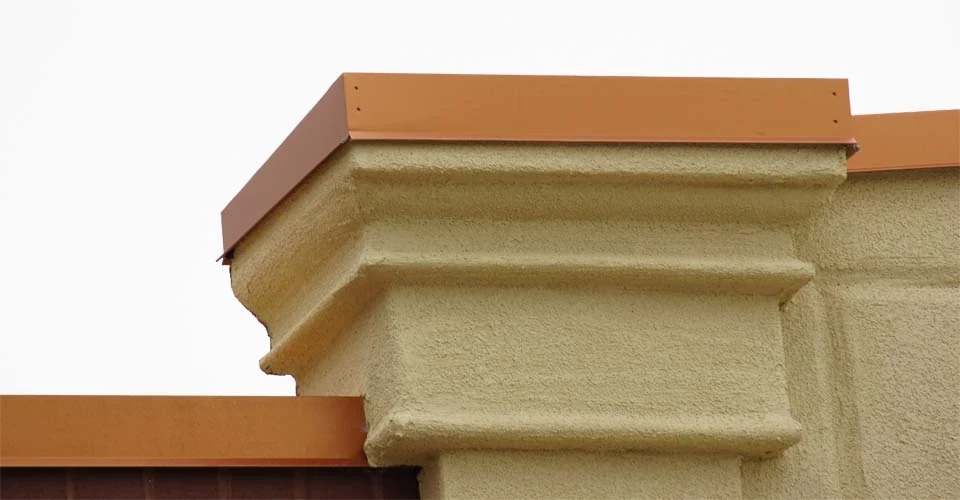
We fasten and seam coping and edge metal to account for both the static load of drifted snow sitting against it for weeks and the dynamic load of wind trying to lift it during a storm. That means continuous cleats rather than face-fastened panels wherever the detail allows, sealed and lapped seams rather than butted joints, and expansion joints placed to handle Pennsylvania's real temperature swing between summer and winter without buckling the metal.
On buildings with a documented history of ice-dam intrusion at a specific stretch of parapet, we look at whether the underlying insulation taper is contributing to the problem before just replacing the metal, since new coping over a drainage problem that was never fixed just delays the same failure.
Gutters and Downspouts Sized for Real Snowmelt Volume
Gutter systems on the buildings we work on have to handle two very different conditions: routine summer rain, which most gutter systems are sized for by default, and the concentrated volume of a fast spring thaw, when weeks of accumulated snowpack can come off a roof in a matter of days. Undersized gutters and downspouts that work fine every summer can be the exact bottleneck that causes ice buildup and backup at the eave come thaw season.
A handful of specific conditions get checked on every edge metal and gutter scope before we finalize a repair or replacement plan:
- Snow drift and load pattern specific to that section of parapet or eave
- Gutter and downspout capacity against the roof's total drainage area, beyond its raw length
- Fastening spec matched to the site's real wind exposure, not a generic minimum
- Condition of the substrate wall or blocking the coping and edge metal are anchored to
- Existing ice-dam history at that specific run of edge, if any
- Thermal expansion joints and how far apart the existing runs were placed
Heat cable is sometimes part of the answer on a persistent ice-dam stretch, but we treat it as a supplement to a properly built edge detail, not a substitute for one, since heat cable that is protecting a poorly sealed coping joint is just delaying the same failure at higher energy cost.
Edge Work as Part of a Larger Roof Plan
Coping and gutter repairs rarely happen in isolation on our jobs. If we are already on a roof for a tear-off and replacement, edge metal gets rebuilt as part of that same scope rather than left as an old detail on a new membrane, since mismatched old and new terminations are a common leak point we would rather not create. On a roof not otherwise under work, we scope edge repairs on their own when an inspection flags them as a standalone risk.
Edge Metal and Gutter Questions We Get
Why does our roof keep ice-damming at the same spot every winter?
Usually a combination of an insulation taper issue directing melt to that spot and an edge detail that is not sealed well enough to resist the water once it refreezes there. We look at both before recommending a fix.
Can you replace just a section of coping instead of the whole run?
Often yes, if the surrounding sections are sound and the substrate underneath the section being replaced is in good condition, though we will flag it if a partial repair risks an awkward transition.
Do our gutters need to be bigger for this climate?
Frequently, yes, especially on roofs originally built to a generic spec rather than sized for spring thaw volume. We size any replacement against your roof's actual drainage area.
Is heat cable a permanent fix for ice damming?
On its own, no. It manages symptoms at ongoing energy cost. We would rather fix the underlying edge detail and insulation taper and use heat cable only where physical constraints leave no better option.
How do you keep coping from lifting in a wind event?
Continuous cleat fastening and properly lapped, sealed seams, specified to the site's real exposure category rather than a generic minimum fastening pattern.
Ready to review the roof scope?
Request a Roof AssessmentRelated Commercial Roofing