Standing Seam Metal Roofing in Scranton, PA
Standing Seam Metal for Offices and Retail Around Clarks Summit
Standing seam metal shows up on buildings where appearance matters and where a steep-slope roof genuinely sheds snow better than a flat one. We install it most often on professional office buildings, medical offices, and retail developments where both of those things are true at once.
Standing Seam for Architectural and Professional Buildings
The Abington retail and professional office corridor around Clarks Summit has a lot of newer construction with architectural rooflines, and standing seam metal fits that aesthetic in a way single-ply membrane never could on a visible steep-slope section. The concealed fastener design also gives a cleaner look than exposed-fastener metal, which matters on a building where the roofline is part of how tenants and customers perceive the property.
Glenmaura's corporate center in Moosic has similar buildings where the roof is visible from the parking lot and approach road, and property owners there specify standing seam for the same combination of durability and appearance.
Snow Shedding Off Steep-Slope Metal in a Heavy Snow Year
A steep-slope standing seam roof sheds snow through its own pitch and low surface friction, which matters in a region that gets hit by lake-effect bands on top of typical nor'easter accumulation. Snow slides off a well-installed metal roof faster than it does off most other steep-slope materials, reducing the sustained load the structure carries through a heavy winter.
That shedding behavior comes with a tradeoff worth planning for: snow coming off a metal roof lands somewhere, and on a building with an entrance, walkway, or parking area directly below the eave, snow guards or retention systems become part of the design conversation rather than an afterthought.
Panel Profiles and Concealed Fastener Systems
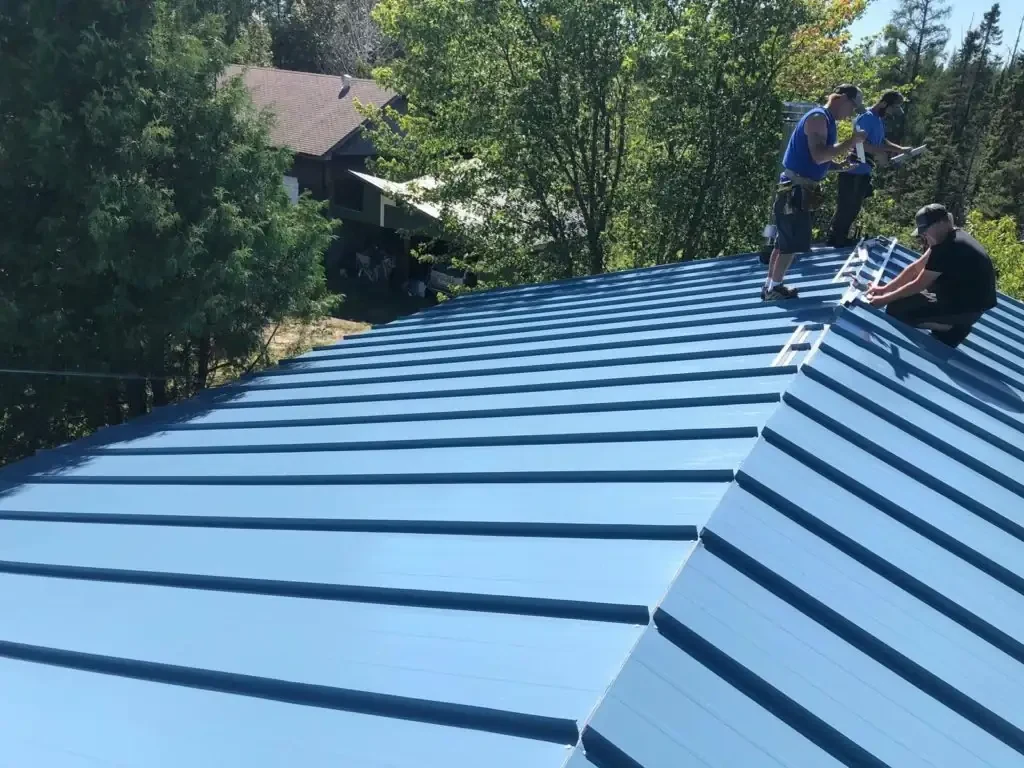
Standing seam panels interlock at raised seams with fasteners concealed underneath, rather than exposed through the panel face like R-panel metal. That detail is what gives standing seam its better long-term watertightness, since there is no exposed fastener to work loose or develop a gasket failure over the years the way exposed-fastener systems eventually do.
Panel width, seam height, and clip spacing all get specified against the building's wind exposure and roof pitch, not picked from a single standard package. A building on higher ground near Clarks Summit sees different wind loading than one down in the valley, and the panel spec should reflect that difference.
Clip type matters too. Fixed clips anchor the panel rigidly, while floating clips allow the panel to expand and contract with temperature swings without stressing the seam. Given how far temperatures swing here across a single winter, we default to floating clip systems on most standing seam installs in this market.
Metal Roofing Over Medical and Professional Office Buildings
Medical office buildings in Kingston, across the river from Wilkes-Barre, often combine standing seam roof sections with flat roof areas over larger floor plates, since a single-story medical building rarely has a uniform roofline. We handle the transition detailing between those two systems carefully, since flashing where a steep metal section meets a flat membrane roof is one of the more common places we find leaks originating on mixed-roof commercial buildings.
These buildings also tend to prioritize a quiet install process more than a warehouse would, given patients and staff working inside during business hours, so we schedule louder cutting and fastening work around clinic hours where possible.
Where Standing Seam Is the Wrong Call
Standing seam is not the answer for every building, and the cost difference compared to single-ply membrane is real. Situations where we typically recommend something else instead:
- Large flat warehouse roofs where a steep-slope system is not structurally or economically practical
- Buildings prioritizing lowest upfront cost over appearance or snow-shedding performance
- Utilitarian industrial buildings where exposed-fastener R-panel meets the need at lower cost
- Roofs with heavy rooftop equipment loads better suited to a flat membrane assembly
- Projects on a tight timeline where standing seam's longer fabrication lead time does not fit
We would rather point a client toward the right system for their building and budget than sell standing seam on a project where it does not actually make sense.
Coating and finish selection is the last piece of the decision. A darker finish absorbs more heat and sheds snow slightly faster, while a lighter finish reflects more solar heat in summer months. On a professional office building with tenants paying attention to both the roofline and the utility bill, we walk through that tradeoff before finalizing the panel order.
Standing Seam Metal Roofing Questions
How does standing seam metal handle the snow load we get in this area?
The steep pitch and low-friction panel surface shed snow faster than most roof types, which reduces sustained structural load, though snow guards may be needed to control where it lands.
Is standing seam more expensive than single-ply membrane?
Generally yes, both in material and install labor, which is why we reserve it for buildings where the appearance and snow performance justify the added cost.
Can standing seam be installed over an existing shingle or metal roof?
Sometimes, depending on the condition of the existing roof deck and structure. We evaluate that during inspection rather than assuming it will work on every building.
How long does a standing seam metal roof typically last?
Properly installed standing seam with a quality coating system routinely delivers several decades of service life with minimal maintenance beyond periodic inspection.
Do you handle the transition where a metal roof meets a flat membrane section?
Yes, that transition detailing is one of the more failure-prone areas on mixed-roof buildings, and we treat it as a specific focus point during both install and inspection.
Ready to review the roof scope?
Request a Roof AssessmentRelated Commercial Roofing